

Many exit planning advisors are highly capable professionals. They understand value growth, transition planning, owner readiness, and the complexity of preparing a business for sale.
Yet many still struggle to grow.
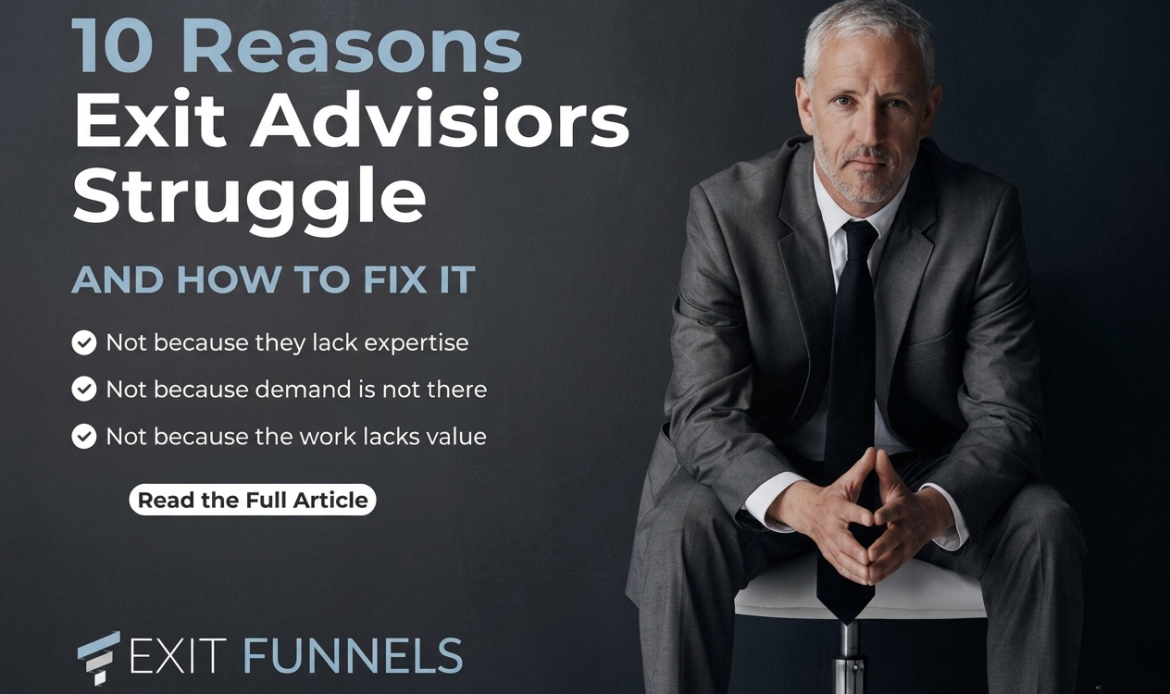
- Not because they lack expertise.
- Not because there is no demand.
- Not because business owners do not need help.
They struggle because expertise alone does not create visibility.
Credentials alone do not generate leads.
And referrals alone do not build a predictable pipeline.
If you are a CEPA or exit planning professional trying to grow your practice, these are 10 of the biggest reasons growth stalls and what to do about it.
1. You are too dependent on referrals
Referrals can be valuable, but they are not a growth system. They are inconsistent, difficult to control, and limited by the size of your current network.
Too many exit planning advisors are still waiting for introductions instead of building a strategy that creates opportunities consistently.
How to fix it
Obviously you want referrals, but stop relying on them as your primary growth engine. Build proactive channels that help you reach business owners directly through targeted outreach, educational content, lead magnets, and long-term nurture.
2. You do not have a predictable pipeline
Most advisors are not short on credibility. They are short on consistency.
One month there are conversations. The next month there is silence. That is what happens when there is no real system for attracting and capturing qualified opportunities.
How to fix it
Create a pipeline strategy built around visibility, lead capture, and follow-up. If there is no system producing ongoing conversations, growth will always feel unpredictable.
3. You are showing up too late in the owner’s journey
Most business owners do not wake up one day ready to hire an exit planning advisor. They go through a long period of thinking, questioning, hesitating, and exploring before they take action.
If your visibility begins only when they are transaction-ready, you are already late.
How to fix it
Position yourself where owners begin thinking about readiness, not where they finish it. Publish educational content, create early-stage resources, and speak to the issues owners feel before they raise their hand.
4. Your value is clear to you, but not to the prospect
Many business owners do not fully understand what an exit planning advisor does. They may understand M&A. They may understand wealth management. They may understand tax planning. But exit planning often feels vague unless it is communicated clearly.
When the value is unclear, the prospect delays.
How to fix it
Stop leading with titles and industry language. Start leading with outcomes, problems, and missed opportunities. Make it easy for owners to understand why planning early matters and what is at risk if they wait.
5. You are not educating the market early enough
One of the biggest mistakes exit planning advisors make is assuming the market already understands the importance of exit planning.
It does not.
Business owners often wait too long because no one has clearly shown them what readiness actually means, what poor planning can cost them, or why the process should start years before a transition.
How to fix it
Use content to educate before you try to convert. Blog articles, webinars, guides, videos, assessments, scorecards, and executive briefings can help business owners understand the problem before they are asked to engage.
6. You are blending in with every other advisor
From the outside, many advisors look the same. Similar language. Similar credentials. Similar promises. Similar websites.
When that happens, the market sees you as interchangeable.
How to fix it
Sharpen your positioning. Clarify who you help, what perspective you bring, and what makes your approach different. Advisors who can clearly articulate their point of view are easier to remember and easier to trust.
7. You are not addressing the personal side of exit
Too many advisors focus only on business value, financial and operational readiness while ignoring identity, purpose, family dynamics, and life after the sale.
That is a missed opportunity.
Owners do not just need help selling well. They need help transitioning well.
How to fix it
Differentiate your messaging by speaking to the full exit journey, including personal readiness. This creates stronger positioning and deeper relevance, especially for owners who are anxious about what comes next.
8. Your follow-up is too weak for a long-cycle sale
Exit planning is rarely an immediate decision. Owners may take months or even years to move forward.
If your follow-up is inconsistent, manual, or nonexistent, warm opportunities will disappear.
How to fix it
Build both short-term and long-term nurture into your client acquisition system. Stay visible with educational follow-up, periodic touchpoints, CRM tracking, and messaging aligned to the owner’s stage of readiness.
9. You have marketing activity, but no conversion system
A few LinkedIn posts are not a system. A website is not a system. A webinar is not a system.
Many advisors are doing pieces of marketing without having a connected structure that moves a prospect from interest to action.
How to fix it
Build conversion infrastructure. That means clear calls to action, landing pages, lead capture, automated follow-up, appointment workflows, and a CRM that supports the full client acquisition journey.
10. You have expertise, but no client acquisition framework
This is the root problem behind most stalled growth.
Many CEPAs and exit planning professionals are excellent at the advisory work itself, but they have never built the infrastructure required to consistently attract, nurture, and convert qualified prospects.
Without that framework, growth stays reactive.
How to fix it
Treat client acquisition as a system, not a series of disconnected tactics. The advisors who grow most consistently are the ones who build structure around visibility, authority, capture, nurture, and conversion.
The Real Fix: Build a Stronger Client Acquisition System
If you want to grow your practice more predictably, you need more than referrals, networking, and a decent website.
You need a client acquisition system.
Here are the five core components.
1. Clear positioning
Your market should immediately understand who you help, what problem you solve, and why your approach is different.
2. Authority-building content
You need content that builds trust and demonstrates expertise before the first conversation ever happens.
3. Targeted lead capture
You need a way to turn interest into an actual lead through guides, scorecards, landing pages, webinars, or consultation requests.
4. Automated nurture
You need follow-up systems that keep you visible across a long decision cycle, without relying on manual effort alone.
5. Conversion infrastructure
You need a connected process that moves a prospect from attention to inquiry to discovery call to client engagement.
Final Thoughts
The problem is not that CEPAs and exit planning advisors lack value.
The problem is that too many are still relying on reputation, referrals, and occasional marketing activity in a market that now requires more structure.
If you want to build a stronger practice, you need more than expertise. You need a system that helps the right business owners find you, understand your value, stay connected to your message, and take the next step when the timing is right.
- That is how visibility becomes opportunity.
- That is how authority becomes engagement.
- And that is how growth becomes more predictable.
Want to build a more structured client acquisition system for your exit planning practice? Schedule a discovery call to explore what that could look like.