

Referrals are great.
In fact, for most certified exit planning advisors, referrals are probably one of the best sources of new client opportunities.
They are warm. They come with some level of trust already established. They usually convert better than cold opportunities. And when a business owner is introduced by a CPA, attorney, wealth advisor, banker, consultant, client, or another trusted relationship, the advisor does not have to start the conversation from scratch.
That matters.
In exit planning, trust is not optional. Business owners are not buying a simple service. They are often thinking through one of the biggest transitions of their lives. Their business, their wealth, their family, their employees, their future, and their identity may all be tied to the outcome.
So yes, referrals matter.
They should absolutely be part of a CEPA’s growth strategy.
But they should not be the entire growth strategy.
And that is where many advisors get stuck.
The Problem Is Not Referrals. The Problem Is Depending on Referrals.
When people say that most new advisory clients still come from referrals, many advisors take that as proof that marketing is not important.
I see it differently.
If the majority of new clients are still coming from referrals, that does not mean marketing does not work. It means there is a massive opportunity for advisors who are willing to build a more intentional client acquisition system.
Because here is the reality…
If referrals are your only source of new business, you are not really in control of your growth.
You are waiting…
- Waiting for someone to remember you.
- Waiting for someone to recognize an opportunity.
- Waiting for someone to explain what you do correctly.
- Waiting for someone else to make the introduction.
That may be comfortable, but it is not scalable.
Using referrals as your sole source of new client leads is essentially the same as sitting back and waiting for someone else to grow your business.
That is a dangerous place to be for any advisor who wants to build a more predictable pipeline.
Referrals Are Valuable, But They Are Not Predictable
The biggest strength of referrals is that they come from someone else.
The biggest weakness of referrals is also that they come from someone else.
- You do not fully control the timing.
- You do not fully control the volume.
- You do not fully control the quality.
- You do not fully control whether the referral source understands your value proposition.
- You do not fully control whether they think of you at the right moment.
A referral source may like you, trust you, and respect your expertise. But that does not mean they will consistently send opportunities your way.
A past client may have had a great experience working with you. But that does not mean they will introduce you to another business owner.
A center of influence may know you are a CEPA. But if you are not staying visible, relevant, and easy to remember, they may send the opportunity to someone else.
That is the hidden risk of referral-only growth.
It feels like a relationship strategy, but in many cases, it becomes a passive waiting strategy.
And passive growth has a ceiling.
Many CEPAs Are Qualified. Fewer Are Visible.
Most certified exit planning advisors have real expertise.
They understand the issues business owners need to think about before an exit. They understand value acceleration, succession, owner dependence, leadership readiness, financial preparedness, risk reduction, personal readiness, and life after the sale.
The problem is not usually a lack of knowledge.
The problem is that the right business owners do not know they exist.
That is the gap.
Being qualified is not the same as being visible.
But visibility by itself does not necessarily equal opportunity.
An advisor can be visible on LinkedIn, visible in their local market, visible at events, and visible among referral sources, but if that visibility is not connected to a clear client acquisition system, it rarely turns into predictable pipeline.
Visibility only becomes opportunity when there is a process behind it.
That process needs to help the advisor attract the right audience, capture early interest, educate prospects over time, and give business owners or referral sources a clear next step.
Having the CEPA designation can support credibility. It can help with positioning. It can signal that an advisor understands the exit planning process.
But a credential by itself does not create demand.
- It does not build a pipeline.
- It does not nurture early-stage owners.
- It does not automatically put an advisor in front of the right people at the right time.
That requires a system.
The Cold and Lukewarm Market Is Where Real Scale Happens
Referrals usually come from the warm market. These are people who already know you or who are connected to someone who knows you.
That is extremely valuable.
But the real growth opportunity is often outside of that immediate circle.
The cold market includes business owners, referral sources, strategic partners, and centers of influence who may not know you yet.
The lukewarm market includes people who may have seen your content, connected with you on LinkedIn, attended a webinar, downloaded a guide, taken an assessment, visited your website, or heard your name before but have not yet engaged in a serious conversation.
This is where scale begins.
Not because these people are ready to buy immediately.
Most are not.
But because a structured marketing system gives you the ability to start the relationship earlier.
And in exit planning, earlier is everything.
Most business owners do not wake up one morning and decide they are ready to exit. The thought process often starts years in advance.
They may be wondering:
- Is my business too dependent on me?
- What is my company really worth?
- Do I have the right leadership team in place?
- Are my financials clean enough for a buyer?
- What happens to my employees?
- What happens to my family?
- What do I do after the sale?
- Am I personally ready for life after the business?
Those are not transaction questions. They are readiness questions.
And readiness questions create the perfect opportunity for education-based marketing.
The advisor who shows up early with helpful education has a much better chance of earning trust before the owner is ready to engage.
Marketing Does Not Replace Referrals
This is an important point.
I am not suggesting that advisors should stop pursuing referrals.
Quite the opposite.
Referrals should remain a core part of the growth strategy.
But marketing and referrals should not be viewed as competing strategies.
The best growth strategy uses both.
Referrals create trust through personal introduction.
Marketing creates visibility, education, familiarity, and ongoing relevance.
In many cases, marketing actually makes referrals easier.
Why?
Because referral sources need help understanding how to introduce you.
- They need to know who you serve.
- They need to know what problems you solve.
- They need to know what makes you different.
- They need to be reminded that you exist.
- They need useful content they can share with business owners.
A strong marketing system gives referral sources language, context, and confidence.
It makes you easier to refer.
So the choice is not referrals or marketing.
The right answer is referrals plus marketing.
Relationships plus visibility.
Trust plus systems.
Random Acts of Marketing Are Not Enough
This is where many advisors make another mistake.
They realize referrals are not enough, so they start doing random marketing activity.
- They post on LinkedIn for a few weeks.
- They run an occasional ad.
- They send a few emails.
- They publish a blog article.
- They host one webinar.
Then they stop because nothing happens fast enough.
That is not a client acquisition system.
That is random activity.
A real growth system has structure.
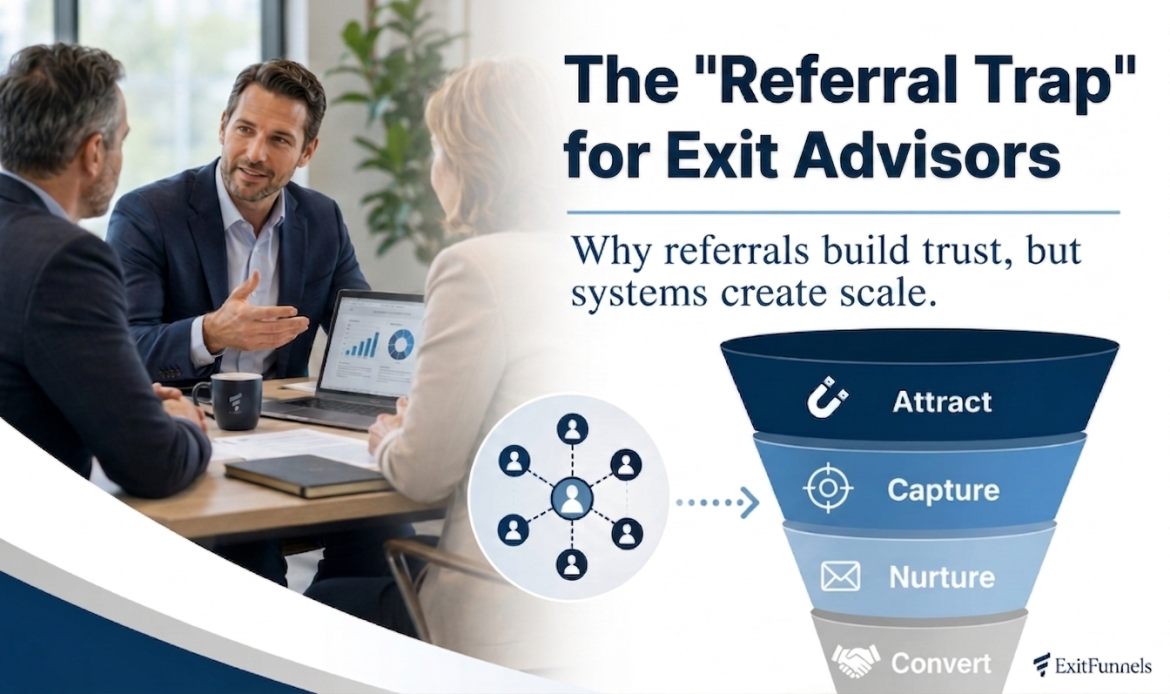
For exit planning advisors, that system should be built around four core functions:
- Attract the right business owners and referral sources with educational content.
- Capture early interest through assessments, guides, checklists, webinars, scorecards, or readiness tools.
- Nurture those relationships over time with relevant follow-up.
- Convert engaged prospects into discovery calls, strategy sessions, readiness reviews, or advisory conversations.
That is how you move from passive growth to intentional growth.
That is how visibility becomes pipeline.
And that is how early-stage interest turns into real opportunity over time.
The Real Opportunity for CEPAs
If most new clients still come from referrals, advisors should not interpret that as a reason to ignore marketing.
They should interpret it as a signal.
It means the cold and lukewarm market is still underdeveloped.
It means many business owners are not being reached early enough.
It means many referral sources are not being nurtured consistently.
It means many CEPAs are still relying on their existing network instead of intentionally expanding their market.
For advisors who want a lifestyle practice, referral-based growth may be enough.
But for CEPAs who want to scale, referrals alone are not a real growth engine.
They are too inconsistent.
- Too dependent on other people.
- Too difficult to forecast.
- Too hard to control.
The advisors who will grow the strongest practices are not the ones who sit back and wait for the next introduction.
They are the ones who build a system that expands visibility, educates the market, captures interest, nurtures relationships, and creates opportunity on purpose.
Referrals are valuable.
Relationships matter.
Trust is essential.
But if you want predictable growth, you need more than referrals.
You need a client acquisition system.
Because the question is not whether referrals work.
They do.
The better question is this:
Are you willing to let someone else control the growth of your practice, or are you ready to build a system that creates opportunity by design?